

If you are wondering how long is 30 feet, the answer is 360 inches, 9.144 meters, or 914.4 centimeters. Thirty feet is a considerable length that can help describe the dimensions of a room, the length of a recreational vehicle, a large banner, a cable, a boat, or an outdoor space. Although it may be difficult to visualize this distance at first, comparing it with familiar objects and everyday spaces can make it easier to understand.
Thirty feet is equal to 10 yards and approximately 9.14 meters. It is also three times the length of a 10-feet section, making it a useful measurement for estimating longer distances. Whether you are planning a home project, measuring a backyard, checking the dimensions of a large object, or simply curious about this length, understanding 30 feet can help you make better estimates.
How Long Is 30 Feet?
30 feet is equal to 360 inches, 9.144 meters, or 914.4 centimeters. It is a useful length to visualize when measuring rooms, outdoor spaces, and everyday objects.
How Long Is 30 Feet?
Explore the equivalent measurements to understand this length.
30 feet contains 360 inches.
30 feet measures 9.144 meters.
30 feet equals exactly 10 yards.
How Long Is 30 Feet?
30 feet equals 360 inches, 10 yards, 9.144 meters, or 914.4 centimeters. It is a little longer than 9 meters and approximately the length of a large recreational vehicle or a long indoor space.
For a quick mental estimate, imagine three separate sections, each measuring 10 feet. Placing these sections end to end gives you a total length of 30 feet. You can also visualize 30 feet as ten 3-feet sections arranged in a straight line.
30 Feet in Different Measurements
Converting 30 feet into other units makes it easier to understand, especially when comparing measurements from different countries or product descriptions.
| Measurement Unit | Equivalent to 30 Feet |
|---|---|
| Feet | 30 feet |
| Inches | 360 inches |
| Yards | 10 yards |
| Centimeters | 914.4 cm |
| Meters | 9.144 m |
| Millimeters | 9,144 mm |
The most useful conversions to remember are 30 feet = 360 inches and 30 feet = 9.144 meters. If you use the metric system, you can think of 30 feet as slightly longer than 9 meters.
What Does 30 Feet Look Like?
Thirty feet is a long distance compared with most household objects. It is much longer than a standard bed, a dining table, or a typical sofa. To visualize it, imagine placing several familiar objects end to end until their combined length reaches 30 feet.
For example, three 10-feet sections placed in a straight line add up to exactly 30 feet. Alternatively, ten sections measuring 3 feet each produce the same total length.
You can also use a large room, driveway, or backyard as a visual reference. Some indoor spaces and outdoor areas may extend approximately 30 feet from one end to the other. Measuring the space is the best way to confirm its actual length.
Why Is Knowing How Long 30 Feet Is Useful?
Understanding 30 feet can be helpful in construction, home improvement, landscaping, event planning, and recreational activities. A homeowner might need to estimate the length of a fence, the distance across a yard, or the amount of cable required for an installation.
It can also be useful when buying long materials. If a decorative banner, fabric roll, rope, or utility cable measures 30 feet, knowing the equivalent in meters and inches helps you understand its total length.
For recreational equipment, vehicle parking, and storage planning, this measurement can help you estimate whether an item will fit within a particular area. However, always verify the manufacturer’s dimensions before making decisions that require precise measurements.
Read More: How Long Is 29 feet ? A Simple Visual Guide
9 Common Things That Help You Visualize 30 Feet
The following examples offer practical ways to imagine a length of 30 feet. Some objects may be close to this measurement, while others can be combined or measured to create an exact 30-feet reference.
1. A Large Recreational Vehicle
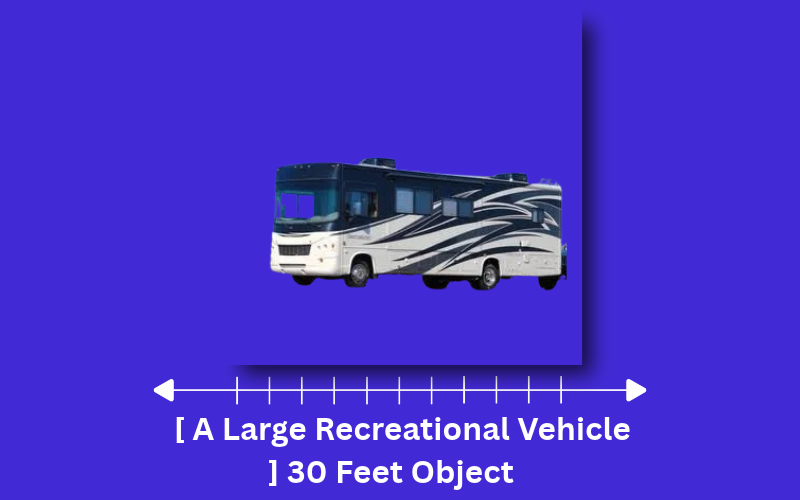
Some large recreational vehicles can measure close to 30 feet in overall length. These vehicles provide a helpful comparison because their dimensions are often discussed in feet, especially when people are choosing parking spaces, campsites, or storage locations.
Imagine a recreational vehicle parked in a long driveway. Its front-to-back length can give you a visual idea of how much space 30 feet occupies. Not every recreational vehicle measures 30 feet, though; smaller models can be considerably shorter, while larger models can exceed this length.
If you are using a recreational vehicle as a reference, check its listed exterior length rather than estimating from its appearance alone.
2. A Long Workshop Bench Arrangement

A workshop bench arrangement extending across a large work area can reach 30 feet when several bench sections are placed together. This setup might be found in a professional workshop, school workshop, production area, or shared workroom.
For example, three bench sections that are each 10 feet long would create a combined length of exactly 30 feet when aligned end to end. This makes the arrangement a practical way to visualize the measurement.
Workshop benches vary in length, so the combined measurement depends on the actual dimensions of each section. This example is particularly useful when planning workspaces or arranging equipment along a wall.
3. A Long Wooden Board Arrangement

Wooden boards can help illustrate 30 feet because they are commonly measured and cut according to specific lengths. Three boards that are each 10 feet long would measure 30 feet in total if placed end to end without gaps or overlap.
This comparison is useful for people working on construction projects, woodworking, fencing, or outdoor structures. It shows how a long measurement can be divided into smaller, manageable sections.
Always measure the boards before combining them. Their actual lengths may differ from their advertised nominal sizes, and the total length of an arrangement can change if the boards overlap.
4. A Long Utility Cable

A utility cable measuring 30 feet provides a direct example of this length. Cables are available in many lengths and may be used for electrical installations, networking, audio equipment, or other applications, depending on the cable type.
Imagine laying a 30-feet cable straight along the ground. The distance from one end to the other would represent the full measurement, making it easy to understand how much space 30 feet covers.
When purchasing a cable, check the listed length and intended use. Avoid stretching cables tightly or placing them where people could trip over them.
5. A Large Decorative Banner

A long decorative banner can measure approximately 30 feet when designed for a large venue, outdoor celebration, school event, or commercial display. Banners of this size may be used to decorate fences, stages, building fronts, or event spaces.
A 30-feet banner would stretch across a substantial area compared with a standard wall decoration. Visualizing it across a fence or along the edge of a large event space can help you understand the measurement.
Banner sizes vary according to their purpose, so not every long banner is 30 feet. Always check the specified dimensions before ordering one for a particular location.
6. A Large Boat

Some boats can measure around 30 feet from bow to stern. This length may be found among certain recreational boats, fishing boats, and other watercraft, although boat sizes vary widely.
A boat of this size provides a useful real-world reference because its overall length is usually an important specification. It can help you imagine how far 30 feet extends in an open space.
Keep in mind that a boat’s listed length may be measured differently depending on the manufacturer and whether certain extensions are included. Use the official specifications when accurate dimensions matter.
7. A Long Fabric or Material Roll

A roll of fabric or other flexible material containing 30 feet of length is another helpful comparison. Fabric is often sold by the yard or meter, so understanding the conversion can make purchasing easier.
Since 30 feet equals 10 yards, a 10-yard length of fabric provides exactly 30 feet of material before accounting for any cutting or handling differences. If you unroll it in a straight line, you can see the full distance represented by this measurement.
This example is especially useful for sewing, event decoration, upholstery, and craft projects. Be sure to distinguish the length of the fabric from its width.
8. A Long Extension or Utility Line

Some utility lines can be purchased in lengths of 30 feet. Depending on the product, these may include suitable hoses, ropes, or other lines designed for specific household, garden, or workshop tasks.
A 30-feet line can extend across a large room or a portion of an outdoor area. Laying it out in a straight line provides a clear visual representation of the measurement.
Different products have different safety and usage requirements. Choose a line designed for its intended purpose and follow the manufacturer’s instructions rather than assuming every rope, hose, or cable is interchangeable.
9. A Long Storage Shelf Arrangement

A series of storage shelves can create a combined length of 30 feet. For example, three shelving units that each measure 10 feet across would add up to 30 feet when positioned directly beside one another.
This arrangement might be useful in a warehouse, garage, storeroom, workshop, or large utility area. It demonstrates how a measurement can describe the total length of several connected sections rather than one single object.
When measuring a shelf arrangement, account for gaps between units and any additional space needed for installation or access.
How to Measure 30 Feet Without a Measuring Tape
If you do not have a measuring tape, you can estimate 30 feet by dividing the distance into smaller sections. For example, three sections of 10 feet each add up to 30 feet. Mark each section using a known reference, then combine them carefully.
You can also use a measuring tool that displays meters. Since 30 feet equals 9.144 meters, a distance of just over 9 meters is a close visual estimate. If you only need a rough approximation, 9 meters is a convenient reference.
Another option is to use an object with a verified length and repeat it along the ground. For instance, if a straight board measures exactly 10 feet, placing three measured sections end to end gives 30 feet.
Avoid relying on walking steps as an exact measurement because stride length varies from person to person. For construction, vehicle clearance, or any task where accuracy matters, use a suitable measuring tape or distance-measuring tool.
How to Measure 30 Feet Accurately
To measure 30 feet accurately, place the starting end of a measuring tape at the beginning of the area you want to measure. Extend the tape in a straight line until it reaches the 30-feet mark.
If your measuring tape is shorter than 30 feet, divide the distance into smaller sections. Measure 10 feet three times, marking each endpoint carefully. The total distance should be 30 feet when the sections are placed consecutively without gaps or overlap.
For outdoor spaces, ensure that the tape follows the intended measurement line. If the area is uneven, sloped, or obstructed, you may need to adjust your method or use a suitable distance-measuring instrument.
How Long Is 30 Feet Compared With 10 Feet?
Thirty feet is exactly three times as long as 10 feet. If you place three 10-feet sections end to end, their combined length equals 30 feet.
Ten feet equals 120 inches or approximately 3.048 meters. Therefore, three sections of 10 feet equal 360 inches or 9.144 meters.
This is one of the easiest ways to understand 30 feet because it breaks a large measurement into smaller, familiar parts.
How Long Is 30 Feet Compared With 20 Feet?
Thirty feet is 10 feet longer than 20 feet. It is also one and a half times the length of 20 feet.
If you imagine a 20-feet line and add another 10-feet section to its end, the complete distance becomes 30 feet. This comparison can help when estimating long rooms, outdoor areas, cables, or building materials.
In metric units, 20 feet equals 6.096 meters, while 30 feet equals 9.144 meters. The difference between them is 3.048 meters.
How Long Is 30 Feet Compared With 10 Meters?
Thirty feet is slightly shorter than 10 meters. Thirty feet equals 9.144 meters, which is 0.856 meter less than 10 meters.
This comparison is helpful for people who usually work with metric measurements. If you picture a 10-meter distance, 30 feet would cover most of it but leave a little less than one meter remaining.
For quick estimates, 30 feet is approximately 9.1 meters. When an exact measurement is needed, use 9.144 meters.
How Long Is 30 Feet Compared With a Yard?
Thirty feet equals exactly 10 yards because one yard contains 3 feet. Multiplying 10 yards by 3 feet per yard gives a total of 30 feet.
This conversion can be useful when measuring fabric, sports areas, landscaping materials, or other products sold by the yard.
Remember the basic relationship: 3 feet = 1 yard, and 10 yards = 30 feet.
Common Mistakes When Estimating 30 Feet
One common mistake is assuming that a large object is exactly 30 feet long because it looks close. Recreational vehicles, boats, benches, and rooms come in many different sizes, so visual comparisons should be treated as estimates.
Another mistake is confusing feet with inches. Thirty feet equals 360 inches, not 30 inches. Since 30 inches is only 2.5 feet, confusing these units creates a very large difference.
It is also important to distinguish length from area. Feet describe a linear distance, while square feet describe an area. A space that is 30 feet long does not necessarily have an area of 30 square feet.
Finally, remember that approximate comparisons are useful for visualization, but exact measurements should be verified with a suitable measuring tool.
I hope this article was helpful for you. Visit More articles:
- How Long Is 25 feet ? A Simple Visual Guide
- How Long Is 26 feet ? A Simple Visual Guide
- How Long Is 27 feet ? A Simple Visual Guide
- How Long Is 28 feet ? A Simple Visual Guide
- How Long Is 29 feet ? A Simple Visual Guide
FAQs
How long is 30 feet in inches?
Thirty feet equals exactly 360 inches, because each feet contains 12 inches.
How many meters are in 30 feet?
Thirty feet equals 9.144 meters, which is slightly longer than 9 meters.
How many centimeters are in 30 feet?
Thirty feet equals 914.4 centimeters.
How many yards are in 30 feet?
Thirty feet equals exactly 10 yards, since one yard equals 3 feet.
What everyday objects are about 30 feet long?
Depending on their dimensions, a large recreational vehicle, a boat, a long utility cable, a large banner, or a combined arrangement of benches or wooden boards may measure close to 30 feet.
Is 30 feet longer than 10 meters?
No. Thirty feet equals 9.144 meters, so it is 0.856 meter shorter than 10 meters.
How can I visualize 30 feet without a ruler?
Imagine three 10-feet sections placed end to end. You can also use a known 10-feet object three times or estimate a distance of slightly more than 9 meters.
Is 30 feet a long distance?
Thirty feet is a substantial length for many household objects and indoor spaces, although it is relatively short compared with road distances or large outdoor areas.
How many 3-feet sections make 30 feet?
Ten sections of 3 feet each make exactly 30 feet.
Read More: How Long Is 28 feet ? A Simple Visual Guide
Conclusion
So, how long is 30 feet? Thirty feet equals exactly 360 inches, 10 yards, 9.144 meters, or 914.4 centimeters. It is a substantial everyday measurement that can be easier to understand when compared with large recreational vehicles, long cables, decorative banners, wooden board arrangements, and indoor or outdoor spaces.
You can also visualize 30 feet by combining three sections of 10 feet or ten sections of 3 feet. These simple comparisons help turn a number into a distance that is easier to imagine.
Although everyday objects provide helpful references, their actual dimensions can vary. For accurate results, use a measuring tape or another suitable measuring tool. Remembering that 30 feet is slightly longer than 9 meters and equal to 10 yards will make it easier to estimate this length in daily life.