
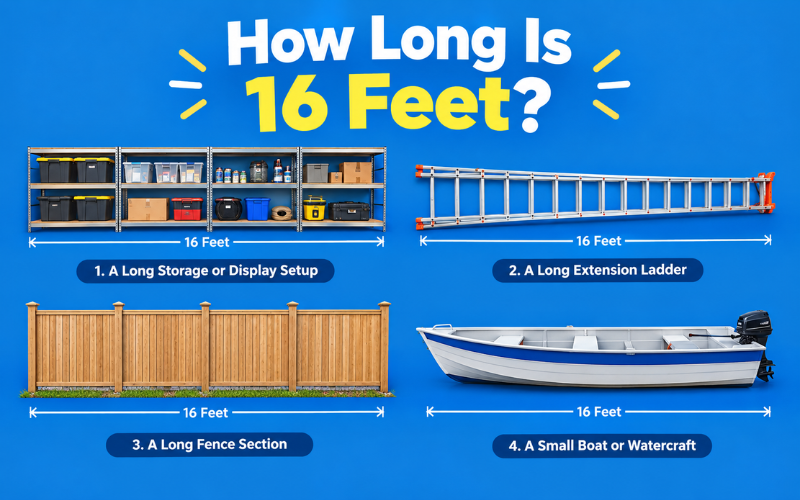
If you are wondering how long is 16 feet, the answer is 16 feet equals 192 inches, 4.8768 meters, or 487.68 centimeters. This length is useful to understand when measuring rooms, furniture arrangements, recreational vehicles, garden spaces, building materials, and other large objects. Although 16 feet may be difficult to visualize at first, comparing it with familiar objects can make the measurement much easier to understand.
Sixteen feet is slightly shorter than 5 meters and approximately the length of a large vehicle or a long room dimension. It is also equal to four 4-feet sections or two 8-feet sections placed end to end. These comparisons provide a simple way to estimate the distance without needing to measure the entire length at once.
How Long Is 16 Feet?
16 feet is equal to 192 inches, 4.8768 meters, or 487.68 centimeters. Explore these measurements with this simple visual guide.
How Long Is 16 Feet?
Compare 16 feet in three commonly used measurement units.
16 feet contains 192 inches because each feet measurement equals 12 inches.
16 feet converts to 4.8768 meters using the standard conversion factor.
16 feet is equivalent to 487.68 centimeters for metric measurements.
How Long Is 16 Feet?
16 feet equals 192 inches, 4.8768 meters, 487.68 centimeters, and 4,876.8 millimeters. It is just over 4.8 meters long and slightly shorter than 5 meters.
For a simple visual reference, imagine four sections that are each 4 feet long. When placed end to end, these sections measure exactly 16 feet. You can also picture two 8-feet lengths combined to create the same distance.
16 Feet in Different Measurements
Converting 16 feet into other measurement units makes it easier to understand, particularly when working with metric measurements.
| Measurement Unit | Equivalent to 16 Feet |
|---|---|
| Feet | 16 feet |
| Inches | 192 inches |
| Yards | 5.333 yards |
| Centimeters | 487.68 cm |
| Meters | 4.8768 m |
| Millimeters | 4,876.8 mm |
The most useful conversions to remember are 16 feet = 192 inches and 16 feet = 4.8768 meters. For quick estimates, you can think of 16 feet as approximately 4.9 meters.
What Does 16 Feet Look Like?
Sixteen feet is a substantial length compared with most household objects. It is much longer than a standard bed, dining table, or typical room door. To visualize it, imagine several large objects or measured sections arranged in a straight line.
One easy comparison is two 8-feet sections. If you place them end to end, their combined length is exactly 16 feet. Similarly, four 4-feet sections make the same total length.
You can also picture a line measuring nearly 5 meters. Since 16 feet equals approximately 4.88 meters, it falls just short of the 5-meter mark.
Another useful reference is a long recreational vehicle or trailer, although actual vehicle dimensions vary widely. Thinking about a vehicle parked alongside a building can help you understand the amount of space that 16 feet occupies.
Why Is Knowing How Long 16 Feet Is Useful?
Knowing how long 16 feet is can be helpful in several practical situations. Homeowners may need this measurement when planning room layouts, choosing furniture, installing long shelves, or estimating the dimensions of outdoor spaces.
It is also useful for construction and DIY projects. Lumber, pipes, rods, trim, and other materials may be sold or cut to particular lengths. Converting 16 feet into inches or meters makes it easier to communicate dimensions and check whether materials will fit the intended area.
For outdoor planning, this measurement can help estimate the length of a garden feature, fence section, driveway space, or recreational equipment. It is important to measure the actual space before making purchases or starting construction because approximate comparisons cannot replace precise measurements.
Read More: How Long Is 15 feet ? A Simple Visual Guide
9 Common Everyday Things That Are About 16 Feet Long
The following examples can help you visualize how long 16 feet is. Some objects may be close to this length, while others can be combined or measured to create an exact 16-feet reference. Actual dimensions depend on the object, model, and design, so use these examples as visual guides rather than guaranteed measurements.
1. A Large Recreational Vehicle
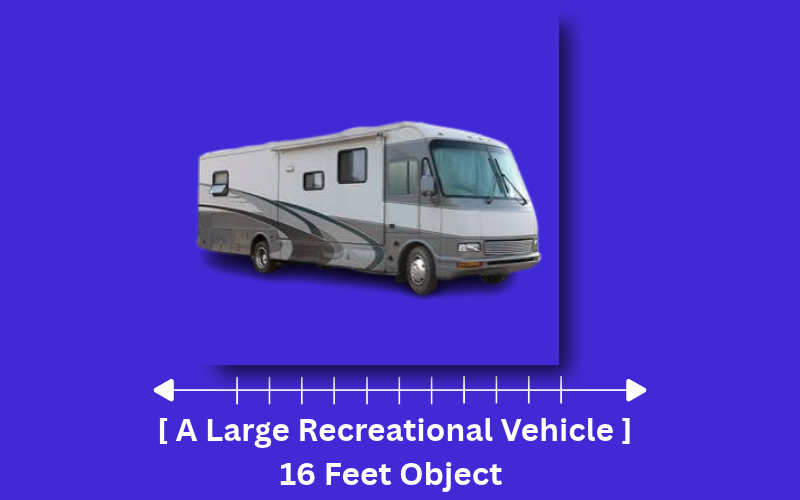
Some recreational vehicles, including compact camper vans and smaller travel trailers, can measure around 16 feet in length. Their dimensions vary depending on the manufacturer, interior layout, and intended use.
A vehicle close to 16 feet long provides a useful real-world comparison because it occupies a noticeable amount of space when parked. Looking at its length beside a house, garage, or parking area can help you understand how much distance 16 feet represents.
However, recreational vehicles are available in many sizes, and many are significantly longer than 16 feet. Always check the vehicle’s listed exterior dimensions when planning storage or parking.
2. A Long Display Board
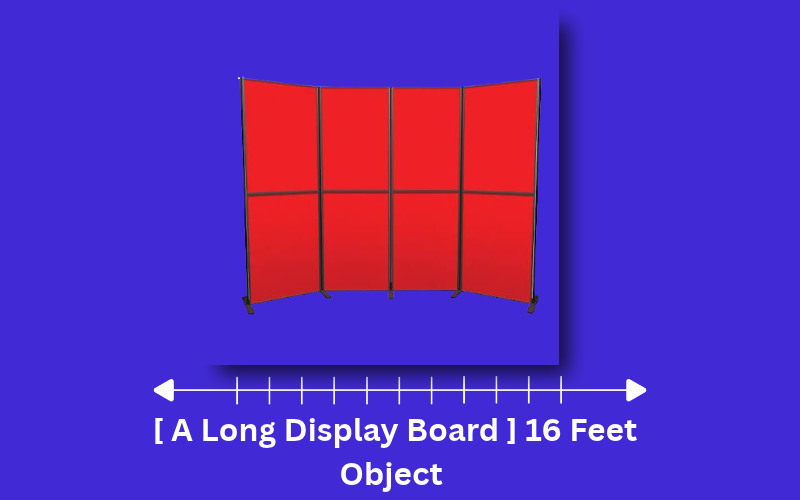
A long display board can be made to measure exactly 16 feet by joining or arranging appropriately sized sections. This type of board may be used for exhibitions, construction projects, workshops, or large display setups.
For example, four boards measuring 4 feet each can create a combined length of 16 feet when aligned end to end. This makes the example particularly useful because the measurement can be checked mathematically.
When working with boards, remember to account for gaps, joints, and any overlap between sections. These details can affect the overall finished length.
3. A Long Dining Table Arrangement
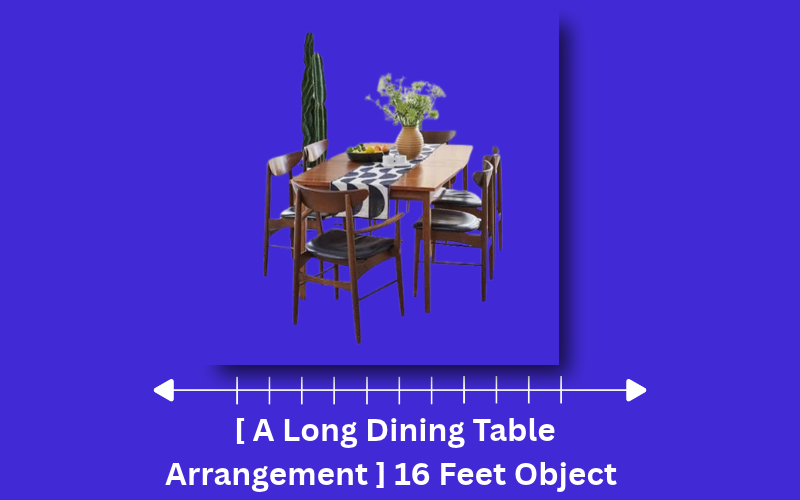
A dining table arrangement can extend to approximately 16 feet when several tables are placed end to end. This setup may be used for large gatherings, events, community meals, or temporary serving areas.
For example, two tables that each measure 8 feet long can form a combined arrangement of 16 feet when aligned without gaps. This makes the comparison especially useful for understanding the measurement in a familiar setting.
Table dimensions vary, so check each table’s length before calculating the total. If there are gaps between the tables, the full arrangement may occupy more space than the combined table lengths alone.
4. A Large Fabric Roll
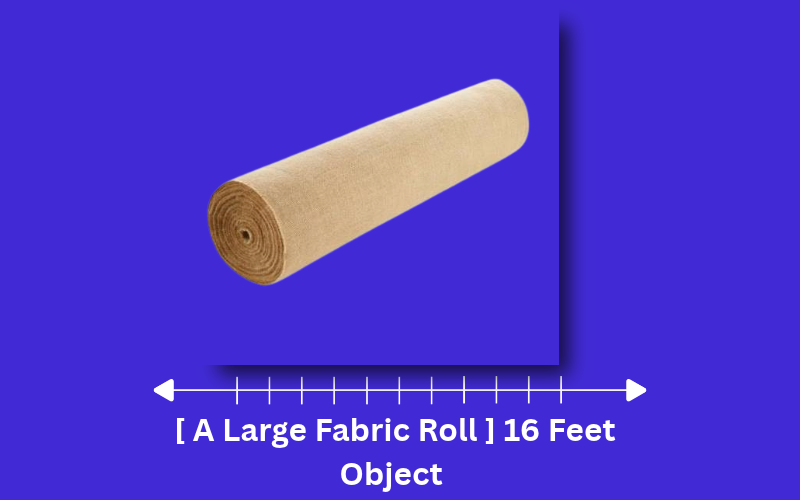
Some fabric rolls or long lengths of material can be measured out to 16 feet. This is a useful example for sewing, upholstery, decorating, event preparation, and craft projects.
A 16-feet length of fabric is long enough to stretch across a substantial part of a room. If the fabric is folded or rolled, however, its visible size will not show its full length.
To measure fabric accurately, lay it flat when possible and use a tape measure along the length. Make sure the fabric is not stretched unevenly or folded in a way that changes the measurement.
5. A Small Boat or Watercraft
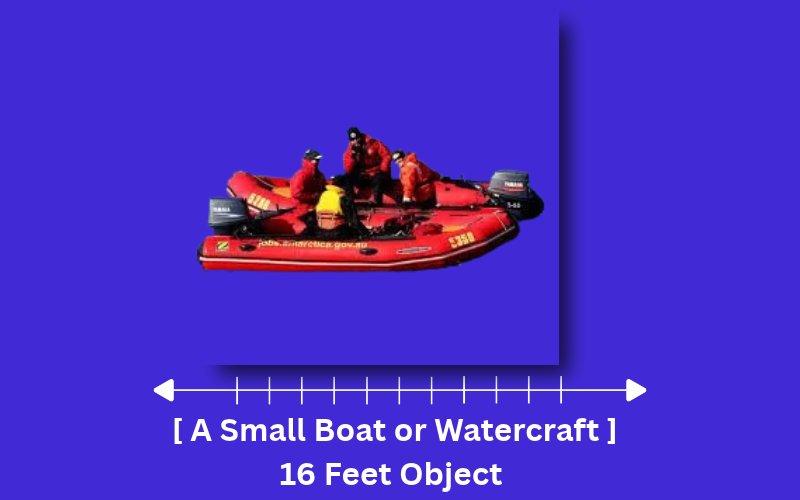
Some compact boats and small watercraft can measure around 16 feet long. Their sizes depend on their design, purpose, and construction, so this is an approximate comparison rather than a universal measurement.
A watercraft close to 16 feet gives you a visual reference for the length of a large object that is longer than most cars’ interior spaces. Seeing one beside a dock or trailer can make the distance easier to imagine.
Because boats vary significantly in size, check the manufacturer’s specifications if you need the exact length for transport, storage, or trailer selection.
6. A Long Fence Section
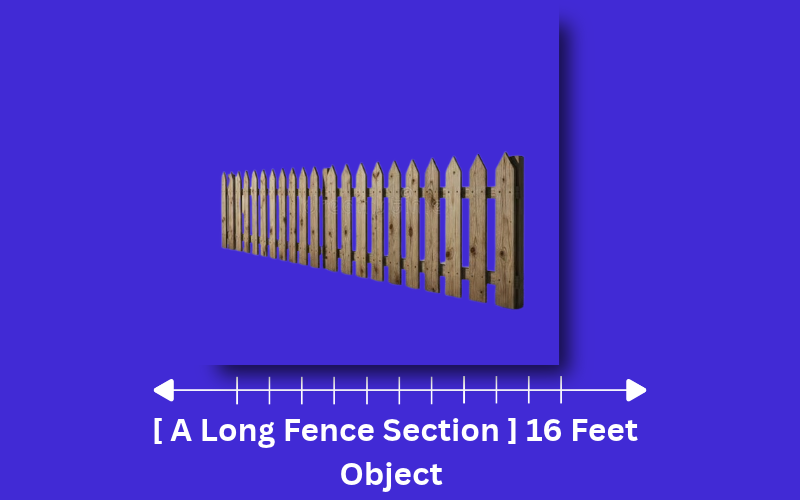
A fence run can measure 16 feet when several panels or sections are combined. For example, four sections that are each 4 feet long create a total length of 16 feet when placed in a straight line.
This comparison is useful for garden planning, yard layouts, and estimating the amount of fencing material required for a small section of a property.
When measuring a fence run, consider the spacing between posts, panel widths, and the way the panels attach. These details can change the total space required, so precise measurements are important before purchasing materials.
7. A Long Pipe or Rod
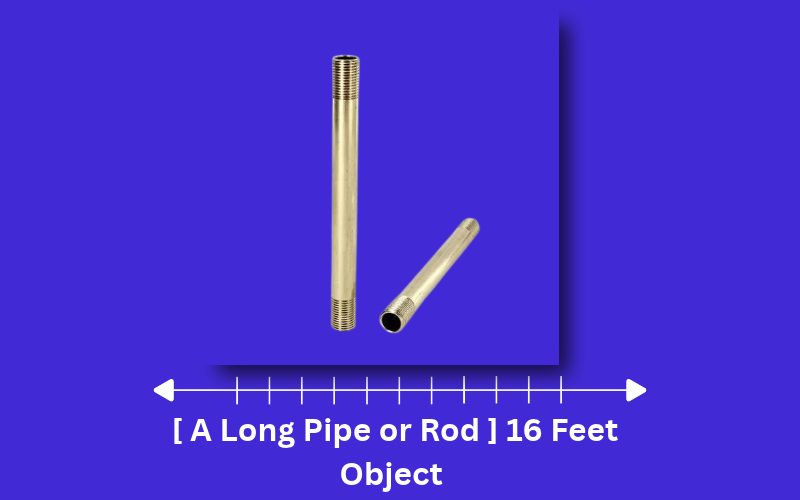
A pipe or rod can be cut to exactly 16 feet, making it a direct example of this measurement. Long pipes and rods are used in construction, plumbing, landscaping, workshop projects, and certain outdoor installations.
Because these materials are straight, their length is relatively easy to measure using a tape measure. A 16-feet pipe has a total length of 192 inches, regardless of its diameter.
If you are transporting or installing a long pipe or rod, consider the available clearance, support points, and handling requirements. The material should be secured properly to prevent movement during transport.
8. A Long Extension Ladder
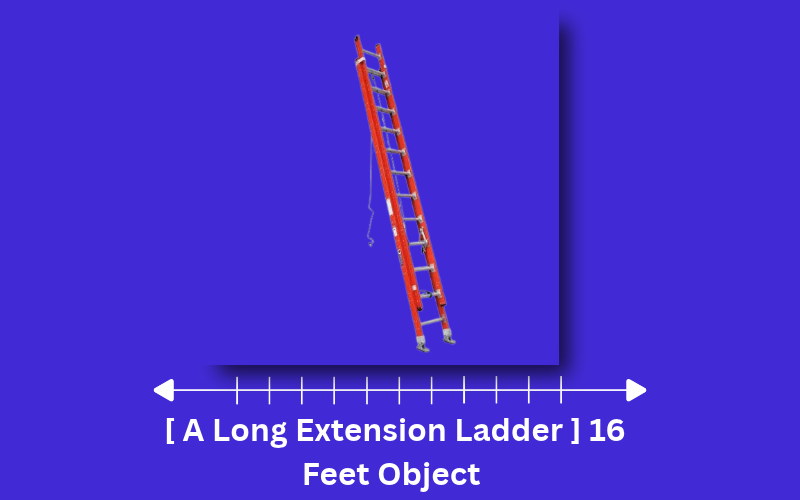
Some extension ladders can reach or exceed 16 feet when extended, although their overall length and usable reach are not the same. Ladder dimensions depend on the ladder type and model.
A ladder is a useful visual reference because it is a long, narrow object that makes the distance easy to see. However, a ladder labeled with a particular length may have a different maximum working reach, and an extension ladder’s sections overlap when stored or extended.
Always check the manufacturer’s specifications and follow the ladder’s safety instructions. Never assume the ladder’s labeled length equals the safe height at which you can work.
9. A Long Storage or Display Setup
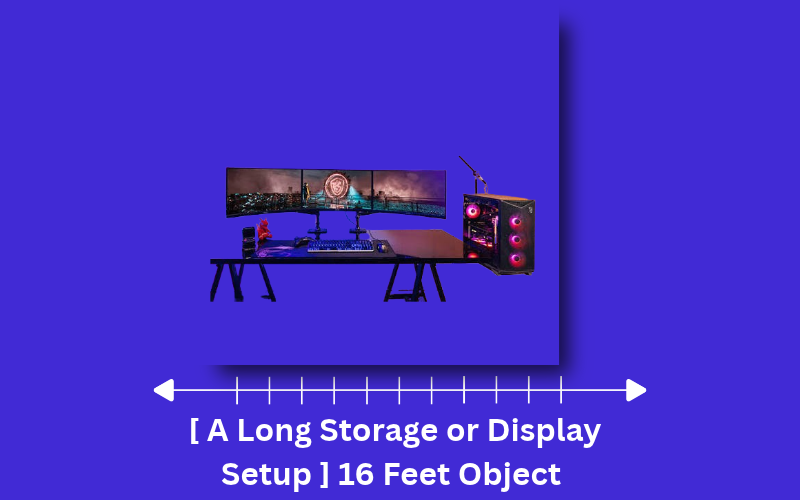
A storage or display setup can extend to 16 feet when several shelves, tables, or display units are arranged in a row. This can be useful for retail displays, workshops, garages, exhibitions, and large storage areas.
For example, four units measuring 4 feet wide each can create a combined arrangement of 16 feet if they are placed directly beside one another without gaps. This provides a straightforward way to picture the overall length.
Before setting up a long arrangement, measure the available floor space and account for corners, access paths, doors, and other obstacles. The total width of the units should be checked rather than estimated visually.
How to Measure 16 Feet Without a Ruler
If you do not have a long ruler, you can measure 16 feet by dividing the distance into smaller sections.
One simple method is to mark four sections of 4 feet each. Measure the first section, mark its endpoint, and repeat the process three more times. The endpoint of the fourth section will be 16 feet from the starting point.
Another method is to combine two measured sections of 8 feet. If you have a tape measure that reaches 8 feet, mark that distance twice in a straight line.
You can also use the metric equivalent. Sixteen feet equals 4.8768 meters, so measuring approximately 4.88 meters provides a close metric reference. For accurate work, use a suitable measuring tape and keep it straight and taut without stretching it.
How to Read 16 Feet on a Measuring Tape
Most measuring tapes used for construction and household projects display inches and feet, or at least inches. To locate 16 feet, remember that each feet contains 12 inches.
Sixteen feet equals 192 inches. If your tape shows only inches, find the 192-inch mark. If it displays feet, locate the 16-feet marking.
When measuring a large space, place the tape’s starting point at the beginning of the area and extend it carefully to the endpoint. Ask someone to hold the far end if needed, and avoid letting the tape bend or sag.
For an accurate measurement, check that the tape is aligned with the direction you want to measure. Measuring diagonally across an area will give a different result from measuring straight along its length.
How Long Is 16 Feet Compared With 5 Meters?
Sixteen feet is slightly shorter than 5 meters. A 5-meter length equals approximately 16.404 feet, while 16 feet equals 4.8768 meters.
The difference is about 12.32 centimeters. This means that if you imagine a line exactly 5 meters long, the 16-feet mark would fall a little before the end.
This comparison is helpful when switching between metric and imperial measurements for construction, home improvement, and room planning.
How Long Is 16 Feet Compared With 12 Feet?
Sixteen feet is 4 feet longer than 12 feet. In inches, 16 feet equals 192 inches, while 12 feet equals 144 inches.
The difference is 48 inches, which is the same as 4 feet. You can visualize the comparison by imagining a 12-feet section followed by an additional 4-feet section.
This is useful when estimating the size of long objects, furniture arrangements, and building materials.
How Long Is 16 Feet Compared With 20 Feet?
Sixteen feet is 4 feet shorter than 20 feet. Twenty feet equals 240 inches, whereas 16 feet equals 192 inches.
The difference between the two lengths is 48 inches, or 4 feet. If you imagine a 20-feet line, removing one 4-feet section leaves a length of exactly 16 feet.
This comparison can help when evaluating room dimensions, vehicle lengths, or long construction materials.
Common Mistakes When Estimating 16 Feet
One common mistake is relying entirely on visual estimates. A vehicle, table arrangement, or room may look close to 16 feet, but actual dimensions can vary considerably. Always check the measurements when accuracy matters.
Another mistake is confusing an object’s total length with the space it occupies. A flexible hose or cord may be 16 feet long but cover a shorter straight-line distance when it bends.
People may also mix up feet, inches, and meters. Remember that 16 feet equals 192 inches and approximately 4.88 meters. Converting the measurement before beginning a project can help prevent calculation errors.
Finally, when combining multiple sections, account for gaps and overlaps. Four 4-feet sections total 16 feet only when their lengths are added without any overlap or unaccounted spacing.
I hope this article was helpful for you. Visit More articles:
- How Long Is 11 feet ? A Simple Visual Guide
- How Long Is 12 feet ? A Simple Visual Guide
- How Long Is 13 feet ? A Simple Visual Guide
- How Long Is 14 feet ? A Simple Visual Guide
- How Long Is 15 feet ? A Simple Visual Guide
FAQs
How long is 16 feet in inches?
Sixteen feet equals exactly 192 inches because each feet contains 12 inches.
How many meters are in 16 feet?
Sixteen feet equals 4.8768 meters, which is approximately 4.88 meters.
How many centimeters are in 16 feet?
Sixteen feet equals 487.68 centimeters.
Is 16 feet longer than 5 meters?
No. Sixteen feet equals 4.8768 meters, so it is approximately 12.32 centimeters shorter than 5 meters.
What everyday objects are about 16 feet long?
Some compact recreational vehicles, long material sections, pipe or rod setups, and combined table or fence arrangements may measure around 16 feet. Their exact dimensions depend on the design and configuration.
How can I measure 16 feet without a long ruler?
Measure four 4-feet sections or two 8-feet sections and combine them in a straight line. A tape measure is the most reliable tool for checking the total distance.
How many yards are in 16 feet?
Sixteen feet equals 5⅓ yards, or approximately 5.333 yards.
Is 16 feet close to 5 meters?
Yes. Sixteen feet equals 4.8768 meters, making it just under 5 meters.
How many 4-feet sections make 16 feet?
Four sections of 4 feet each equal exactly 16 feet.
Read More: How Long Is 14 feet ? A Simple Visual Guide
Conclusion
So, how long is 16 feet? Sixteen feet equals 192 inches, 487.68 centimeters, or 4.8768 meters. It is a little shorter than 5 meters and can be visualized as four 4-feet sections or two 8-feet sections placed end to end.
Everyday comparisons such as a recreational vehicle, a long pipe, a fence section, a room dimension, or a combined table arrangement can help you picture this length. However, the actual sizes of these objects vary, so use their listed dimensions when you need an accurate measurement.
For a quick mental reference, remember that 16 feet is approximately 4.88 meters. Whether you are planning a home project, measuring a garden, arranging furniture, or checking the size of a large object, understanding this measurement can make your estimates more practical and reliable.