
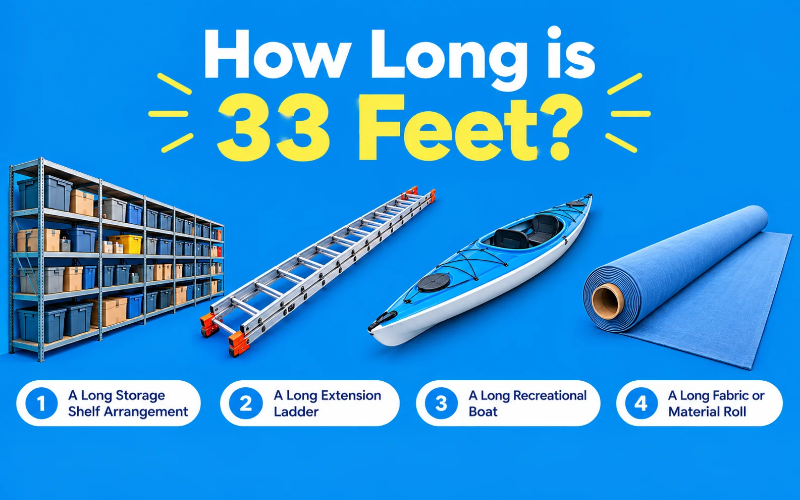
How long is 33 feet? 33 feet is equal to 396 inches, 10.0584 meters, or approximately 10.06 meters. This length is a little longer than the width of two average cars parked side by side and can be compared to several familiar objects, structures, and everyday spaces. Although 33 feet may be difficult to picture from a number alone, comparing it with familiar items can make the measurement easier to understand.
A length of 33 feet is useful in many real-world situations. You might need to estimate the length of a room, plan a garden, measure a driveway, arrange equipment, or determine whether a long object will fit in a particular space. Understanding this measurement can help you visualize distances before using a measuring tape.
How Long Is 33 Feet?
33 feet is equal to 396 inches, 10.0584 meters, or 1,005.84 centimeters. This measurement can help you understand the length of large spaces, outdoor areas, and long objects.
How Long Is 33 Feet?
Explore the equivalent measurements in different units.
33 feet contains 396 inches.
33 feet measures 10.0584 meters.
33 feet is equivalent to 11 yards.
How Long Is 33 Feet?
33 feet is a measurement of length equal to 396 inches, 11 yards, or approximately 10.06 meters. It is slightly longer than 10 meters, making it easier to visualize if you are familiar with the metric system.
Here are the basic conversions for 33 feet:
- Inches: 396 inches
- Yards: 11 yards
- Meters: Approximately 10.06 meters
- Centimeters: 1,005.84 centimeters
- Millimeters: 10,058.4 millimeters
A length of 33 feet can be visualized using long vehicles, outdoor structures, recreational equipment, and arrangements of smaller objects. The examples below provide practical ways to estimate this distance.
Understanding the Length of 33 Feet
A foot is a unit of length commonly used in the United States for measuring buildings, furniture, rooms, vehicles, and outdoor spaces. One foot contains 12 inches, so calculating the length of 33 feet means multiplying 33 by 12.
The result is 396 inches. If you prefer yards, divide 33 by 3 to get 11 yards. In the metric system, multiply 33 by 0.3048 to get 10.0584 meters.
These conversions show that 33 feet is a substantial length. It is longer than many living rooms, larger than most standard household furniture arrangements, and suitable for describing certain long recreational items or outdoor installations.
However, the exact appearance of 33 feet depends on the shape and arrangement of the object being measured. A long, narrow item may look different from a square area with the same overall length. The comparisons below focus on length rather than total area.
33 Feet Conversion Table
The following table shows how 33 feet compares with other commonly used units of measurement.
| Unit | Equivalent to 33 Feet |
|---|---|
| Inches | 396 inches |
| Feet | 33 feet |
| Yards | 11 yards |
| Meters | 10.0584 meters |
| Centimeters | 1,005.84 centimeters |
| Millimeters | 10,058.4 millimeters |
| Kilometers | 0.0100584 kilometers |
| Miles | Approximately 0.00625 miles |
This table is useful when comparing measurements from different sources. For example, if a product description lists a length in meters, you can remember that 33 feet is just over 10 meters. If you are using a measuring tape marked in inches, the same distance equals 396 inches.
Read More: How Long Is 32 feet ? A Simple Visual Guide
9 Common Objects That Help You Visualize 33 Feet
The easiest way to understand a long measurement is to compare it with objects and spaces you already recognize. The following examples provide practical reference points for visualizing a length of approximately 33 feet.
Keep in mind that these are estimates rather than exact standards. Actual dimensions vary depending on the model, design, manufacturer, and intended use.
1. A Long Recreational Boat
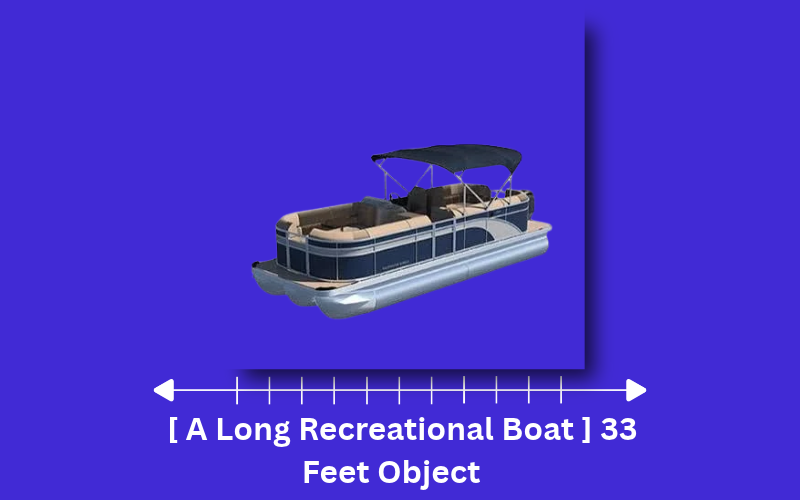
A recreational boat can provide a useful comparison for understanding 33 feet. Some recreational boats are built close to this length, especially models designed for family outings, fishing, cruising, or spending time on the water.
Imagine a boat measuring approximately 33 feet from its bow to its stern. Its length would be slightly greater than 10 meters. This can help you picture how much space such a vessel occupies when stored in a marina, positioned on a trailer, or kept in a suitable storage area.
Boat dimensions vary considerably, so not every recreational boat will match this measurement. When checking a boat’s specifications, pay attention to the listed overall length because features such as platforms or other extensions may affect the total.
2. A Long Extension Ladder

Long extension ladders can help illustrate the scale of 33 feet. Some ladders are marketed with a maximum extended reach or an approximate size near this measurement, although the ladder’s actual length and usable working reach are not necessarily the same.
Picture a ladder extending along the ground for roughly 33 feet. This gives you an idea of the distance involved without needing to imagine a number on a ruler. A ladder of this general size is much longer than an ordinary step ladder and requires careful planning for storage and transportation.
It is important to distinguish between a ladder’s total extended length and the height a person can safely reach while using it. Always follow the manufacturer’s instructions and safety guidelines rather than relying on the nominal measurement alone.
3. A Long Storage Shelf Arrangement
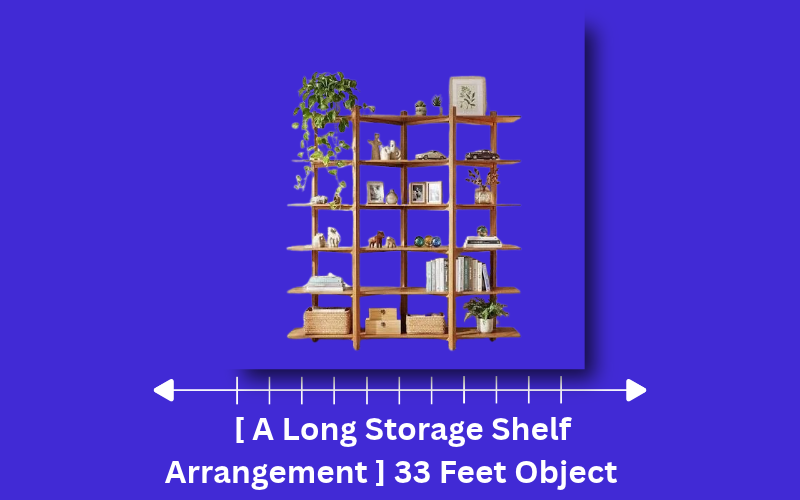
A row of storage shelving can provide another helpful comparison. For example, three shelving sections measuring approximately 11 feet each would create a combined length of 33 feet when arranged end to end.
This type of comparison is useful in warehouses, workshops, garages, and storage rooms. Instead of imagining one enormous shelf, picture several connected sections forming a long line along a wall.
Shelving systems come in different widths, and their measurements may include frames or connecting components. If you are planning a storage arrangement, measure the available wall space and leave enough room for access, doors, and movement around the shelves.
4. A Long Fabric or Material Roll
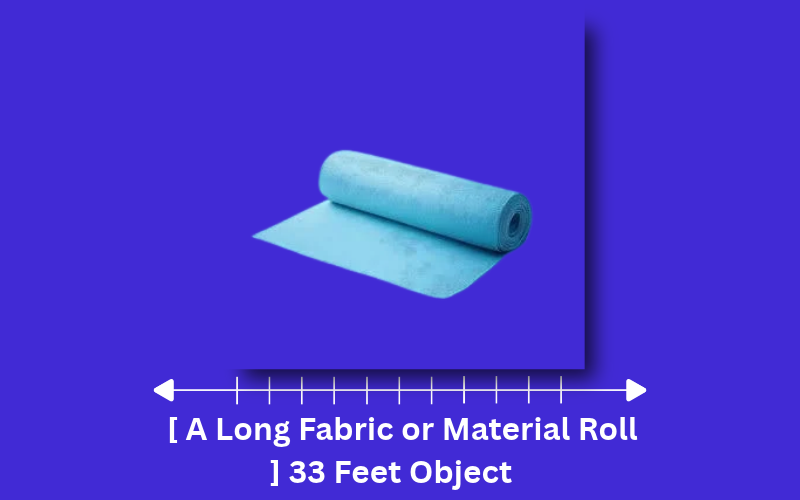
Large rolls of fabric, protective material, landscaping fabric, or similar supplies can help you visualize 33 feet. A roll containing 33 linear feet of material would unfold to a length of 396 inches.
This comparison is especially useful for sewing, decorating, craft projects, and home improvement. You can imagine a long strip of material stretching across a room or along a work area.
Remember that linear feet describe the length of a material, not its width or total surface area. A roll measuring 33 linear feet could be narrow or wide, depending on the product. Always check both dimensions before purchasing materials for a project.
5. A Long Outdoor Banner
An outdoor banner measuring approximately 33 feet from end to end would be a substantial display. Long banners are sometimes used for events, temporary decorations, sports gatherings, community celebrations, or promotional displays.
To visualize this size, imagine a banner stretching across a large outdoor gathering space. Its length would be just over 10 meters, making it much longer than the banners commonly displayed over a small doorway.
The actual size of banners varies based on their purpose. Some are designed to hang horizontally, while others are narrower and longer. When planning a display, consider the available mounting points, the banner’s width, and the conditions in which it will be used.
6. A Long Utility Cable

A cable measuring 33 feet is a helpful example because cables are commonly measured by length. Electrical extension cords, data cables, and other utility cables may be sold in lengths that approach or exceed this distance.
Imagine laying a 33-foot cable in a straight line across an open area. It would cover 396 inches, or approximately 10.06 meters. This can help you estimate whether a cable might span the distance between two locations.
Always choose cables suitable for their intended purpose. Electrical ratings, outdoor suitability, and equipment requirements matter just as much as length. A cable should not be used beyond its rated capacity simply because it reaches the desired location.
7. A Long Workshop Workbench Arrangement

A workshop with multiple workbenches can provide another comparison. Three workbench sections measuring about 11 feet each would create a combined length of 33 feet when aligned in a row.
This example is useful for visualizing industrial workspaces, school workshops, craft rooms, and garages. A long bench arrangement can accommodate different tasks, tools, or workstations along one continuous line.
Real workbenches are usually shorter than 11 feet individually, so the comparison may involve multiple sections. When planning a workshop, remember to account for walking space, storage, doors, and safe access to equipment.
8. A Long Pipe or Rod
A long pipe or rod can illustrate 33 feet because these materials are often measured in linear units. Pipes and rods may be used in construction, plumbing systems, industrial installations, and other projects.
A single piece measuring 33 feet would extend for just over 10 meters. In practice, long materials may be supplied in different standard lengths or assembled from several shorter sections.
This comparison is useful when reading project plans or estimating the size of a long installation. However, pipe length alone does not describe its diameter, thickness, weight, or capacity. Those details must be checked separately when selecting materials.
9. A Long Wooden Board Arrangement

Several wooden boards arranged end to end can demonstrate a combined length of 33 feet. For instance, three boards that each measure 11 feet would produce a total of 33 feet if placed in a straight line without gaps.
This example is particularly useful for carpentry, flooring, fencing, decking, and general home improvement. It lets you visualize a long measurement using materials that are familiar to many homeowners and builders.
In real projects, boards may need to overlap, be cut, or be separated by small gaps. Therefore, the total purchased length may differ from the final measured length. Always account for cuts and waste when calculating the quantity of material required.
How to Measure 33 Feet Without a Measuring Tape
If you do not have a measuring tape, you can still estimate 33 feet by using known dimensions and carefully counting repeated distances.
1. Use a known 10-foot reference. If you have a reliably measured 10-foot section, mark it and repeat the distance three times. This gives you 30 feet, leaving another 3 feet to reach 33 feet.
2. Use a yardstick or measuring stick. Since 33 feet equals 11 yards, you can measure the distance in 11 one-yard sections if you have a suitable measuring tool.
3. Count shorter measured sections. If you have a 3-foot measuring stick, repeat its length 11 times to estimate 33 feet. Keep each section aligned and avoid gaps or overlaps.
4. Use a measuring app cautiously. Some smartphone applications estimate distances using a camera or motion sensors. Their accuracy depends on the device, conditions, and calibration, so verify important measurements with a physical measuring tool.
5. Mark the start and endpoint. For a long distance, place a marker at the starting point and another at the estimated endpoint. This makes it easier to compare the result with a later measurement.
For construction, installation, or purchasing materials, use a suitable tape measure or other reliable measuring equipment rather than depending entirely on visual estimation.
How to Measure 33 Feet With a Measuring Tape
A measuring tape is one of the most straightforward tools for measuring 33 feet. If you have a tape long enough to cover the entire distance, extend it from the starting point to the endpoint and read the measurement carefully.
If your tape is shorter than 33 feet, measure the distance in multiple sections. For example, measure 10 feet, mark the endpoint, and repeat the process. After measuring 30 feet in three sections, measure the remaining 3 feet.
Keep the tape straight and aligned with the area you are measuring. If the tape bends, sags, or follows an uneven path, the result may not represent the intended straight-line distance.
For an outdoor measurement, consider using a second person to help hold the tape and maintain alignment. Make sure the tape is secured and does not create a tripping hazard.
How Long Is 33 Feet Compared With 10 Meters?
33 feet is slightly longer than 10 meters. Exactly 10 meters equals approximately 32.81 feet, so 33 feet exceeds that distance by about 0.19 feet, or approximately 2.28 inches.
This is a helpful comparison for people who use the metric system. If you can picture a 10-meter distance, imagine extending it by a little over 2 inches to approximate 33 feet.
The difference is relatively small, but it can matter when precise measurements are needed. For general visualization, saying that 33 feet is approximately 10 meters is usually convenient. For accurate planning, use the exact conversion of 10.0584 meters.
How Long Is 33 Feet Compared With a Yard?
One yard equals 3 feet, so 33 feet is exactly 11 yards. This makes yard-based comparisons particularly simple because there is no rounding involved.
If you imagine 11 one-yard sections arranged end to end, their combined length is 33 feet. This approach can help when measuring gardens, fabric, sports areas, or outdoor spaces using yard-based measurements.
Remember that a yard measures length, not area. Eleven yards of material describes its length only; the width must be considered separately when calculating how much fabric or other material you need.
Common Mistakes When Estimating 33 Feet
Estimating long distances can be difficult, especially when you rely on familiar objects instead of a measuring tool. Avoid these common mistakes when visualizing or measuring 33 feet.
- Confusing feet with inches: 33 feet equals 396 inches, not 33 inches.
- Forgetting the yard conversion: There are 3 feet in a yard, so 33 feet equals 11 yards.
- Treating examples as exact: Boats, ladders, rooms, and storage systems come in different sizes.
- Ignoring gaps between objects: When adding several object lengths, gaps or overlaps can change the total distance.
- Mixing length and area: A space measuring 33 feet long may have any width, so length alone does not determine its area.
- Estimating without checking: Visual comparisons are useful for understanding scale, but important projects require accurate measurements.
Using the correct unit and verifying the final distance will help you avoid mistakes when planning, building, or purchasing materials.
I hope this article was helpful for you. Visit More articles:
- How Long Is 28 feet ? A Simple Visual Guide
- How Long Is 29 feet ? A Simple Visual Guide
- How Long Is 30 feet ? A Simple Visual Guide
- How Long Is 31 feet ? A Simple Visual Guide
- How Long Is 32 feet ? A Simple Visual Guide
FAQs
How many inches are in 33 feet?
There are 396 inches in 33 feet. To calculate this, multiply 33 by 12 because each foot contains 12 inches.
Is 33 feet longer than 10 meters?
Yes. 33 feet equals 10.0584 meters, which is approximately 5.84 centimeters longer than 10 meters.
How many yards are in 33 feet?
33 feet equals exactly 11 yards. Divide the number of feet by 3 to convert feet into yards.
How many centimeters are in 33 feet?
33 feet equals 1,005.84 centimeters. This is slightly more than 1,000 centimeters, which is equal to 10 meters.
Can I estimate 33 feet without a measuring tape?
Yes. You can use known distances, a yardstick, or repeated measured sections to make an estimate. For accurate construction or installation work, confirm the result with a suitable measuring tool.
What everyday objects are about 33 feet long?
Depending on their dimensions, a recreational boat, a long ladder, a row of shelving, a material roll, or a long outdoor installation may provide a useful comparison. Always check the actual specifications because sizes vary.
Why is it useful to know how long 33 feet is?
Knowing this measurement can help with planning storage, landscaping, room layouts, outdoor installations, and material purchases. It also makes it easier to understand product specifications and compare measurements in feet and meters.
Read More: How Long Is 31 feet ? A Simple Visual Guide
Conclusion
Understanding how long 33 feet is becomes easier when you compare it with familiar objects and spaces. 33 feet equals 396 inches, 11 yards, or approximately 10.06 meters. It is slightly longer than 10 meters and can be visualized through examples such as a long recreational boat, an extension ladder, a storage shelf arrangement, a fence section, or several wooden boards placed end to end.
These comparisons are useful for everyday estimation, home improvement, landscaping, and general measurement planning. However, the dimensions of real-world objects vary, so examples should be treated as visual references rather than exact standards.
For the most accurate result, use a measuring tape or another reliable measuring tool. Once you understand the basic conversions and have a few familiar comparisons in mind, estimating a distance of 33 feet becomes much simpler.